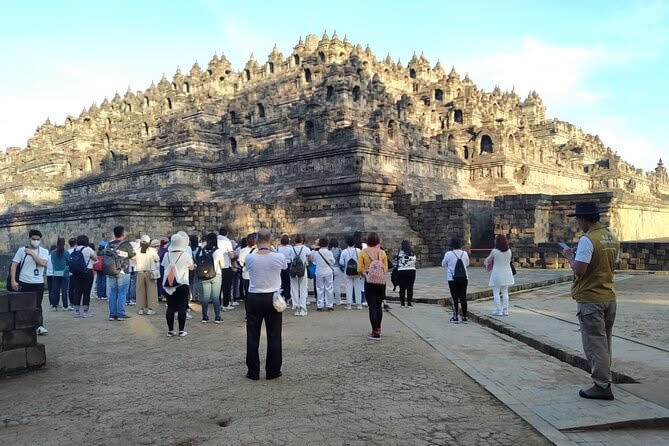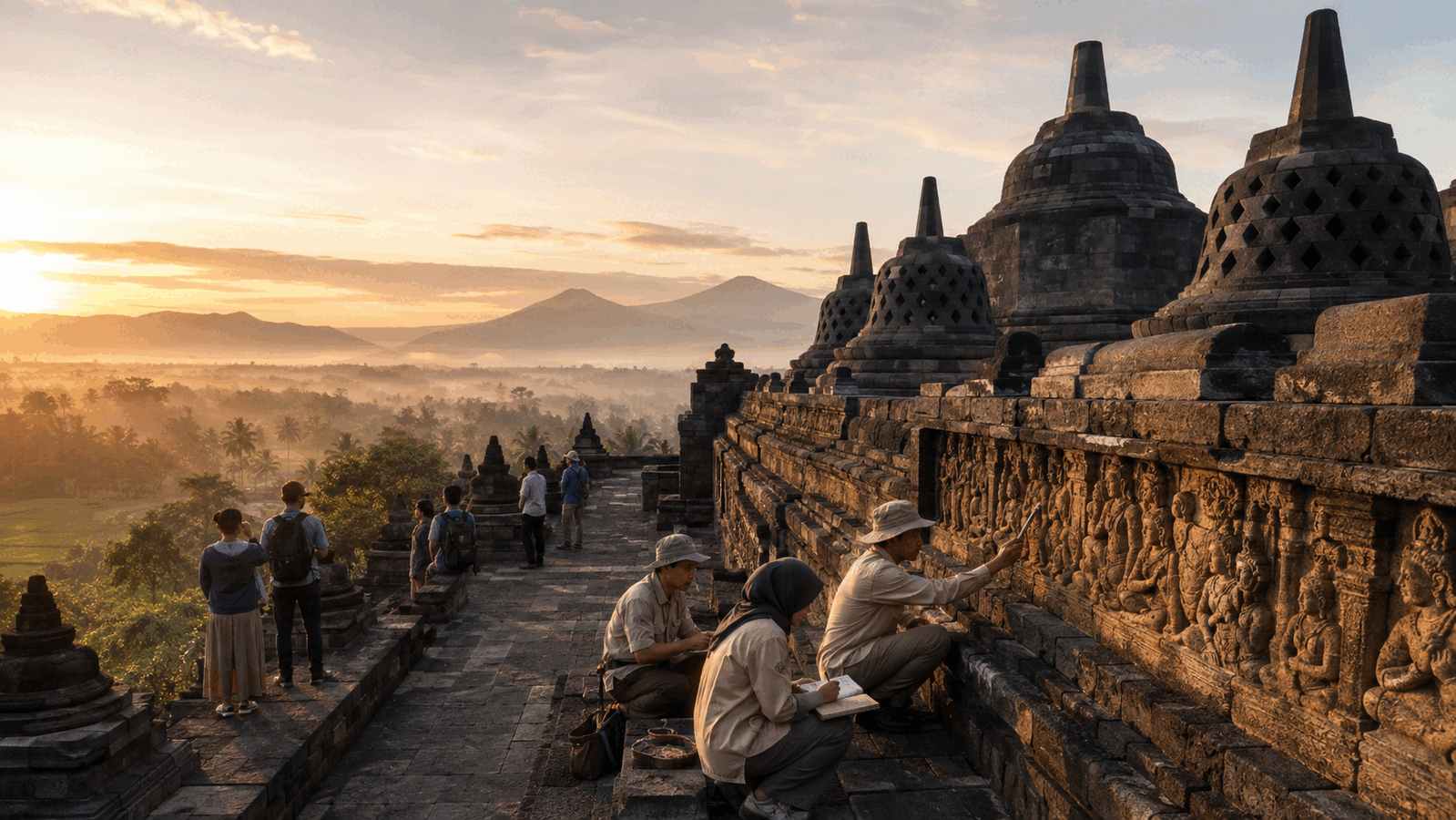
The Borobudur UNESCO Heritage Status represents the global recognition of one of Indonesia’s most important cultural monuments. Located in Central Java, Borobudur stands as an extraordinary example of ancient Buddhist architecture and human creativity.
Many travelers know Borobudur because of its impressive structure and spiritual meaning. However, its greatest international achievement comes from UNESCO World Heritage recognition rather than popularity-based competitions.
UNESCO status confirms that Borobudur has exceptional cultural value that deserves protection for future generations.
The Journey Toward UNESCO Heritage Status
Borobudur was built during the Sailendra Dynasty between the 8th and 9th centuries. The temple reflects the development of Mahayana Buddhism and the artistic achievements of ancient Javanese civilization.
For centuries, Borobudur remained hidden after political changes affected Java. Vegetation and volcanic materials covered parts of the monument, causing it to lose its original function.
The temple was rediscovered in the early 19th century. After extensive research and restoration efforts, experts revealed its historical and architectural importance.
Visitors can discover more about this journey through Why is Borobudur not one of the 7 wonders? The real reason explained.
Why Did UNESCO Recognize Borobudur?
UNESCO recognized Borobudur as a World Heritage Site in 1991 because of its outstanding cultural significance.
The organization evaluates heritage locations using specific criteria. These criteria include historical importance, authenticity, architectural value, and conservation requirements.
Borobudur represents a unique combination of Buddhist philosophy, ancient engineering, and artistic achievement.
Temple demonstrates how religion, architecture, and cultural traditions developed together in ancient Java.
The Cultural Importance of Borobudur
Borobudur UNESCO Heritage Status highlights the temple’s exceptional cultural contribution. The monument contains thousands of relief panels and hundreds of stupas that explain Buddhist teachings.
Relief carvings show stories about morality, spirituality, and daily life in ancient Javanese society.
The temple’s design follows Buddhist cosmology through three symbolic levels: Kamadhatu, Rupadhatu, and Arupadhatu.
These levels represent a spiritual journey from worldly desires toward enlightenment.
Borobudur’s architecture creates a connection between physical space and Buddhist philosophy.
UNESCO Recognition and New7Wonders Difference
The UNESCO Heritage Status of Borobudur differs from the New7Wonders campaign.
UNESCO uses professional evaluation standards to determine cultural importance. The New7Wonders campaign used public voting to select popular landmarks.
Borobudur did not become one of the New7Wonders winners because it did not receive enough votes during the campaign.
However, this result does not affect Borobudur’s UNESCO recognition or historical significance.
UNESCO status shows that the temple has value based on heritage criteria, not only worldwide popularity.
Travelers who want to explore this remarkable monument can join a Borobudur Temple tour to experience its history, architecture, and spiritual meaning.
Protecting Borobudur for Future Generations
UNESCO recognition also supports long-term preservation efforts. Conservation programs help protect Borobudur from environmental damage and human impact.
The restoration project between Indonesia and UNESCO from 1975 to 1982 played an important role in maintaining the temple’s structure.
Today, experts continue monitoring Borobudur to preserve its artistic details and historical value.
The temple remains an important symbol of Indonesia’s cultural identity.
Why Borobudur Remains a Global Heritage Treasure
A monument’s importance does not depend only on rankings or popularity. Cultural influence, historical contribution, and preservation efforts also determine its value.
Borobudur continues to attract visitors because of its unique architecture and deep spiritual meaning.
Its UNESCO Heritage Status proves that the temple represents more than an ancient structure. It represents centuries of knowledge, creativity, and cultural development.
Conclusion
The Borobudur UNESCO Heritage Status confirms the temple’s position as one of the world’s most valuable cultural monuments.
Although Borobudur is not part of the New7Wonders list, UNESCO recognition proves its exceptional historical and cultural importance.
With its ancient architecture, Buddhist symbolism, and remarkable legacy, Borobudur continues to inspire people around the world.